Element - Mask Flow Diagram
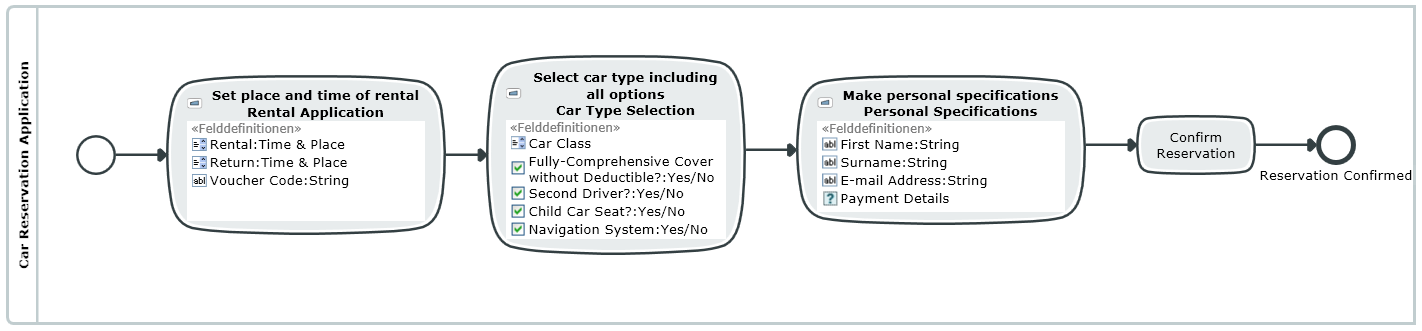
Mask flow diagrams are used for displaying requirements for IT applications in the form of masks, dialogs or windows.
Definition
The mask flow diagram enables users of an IT application in the operating department to communicate their requirements in the form of masks, dialogs or windows.
Innovator for Business Analysts provides a special mask flow notation which was developed based on BPMN. This means that mask flows fit seamlessly with other processes.
The following model elements are used in addition to BPMN elements in mask flow diagrams:
-
User Input Task
A user input task is a special user task, i.e. a semi-automated step such as inputting data in a record mask. You can assign a mask definition to both task types but the mask with be visualized in the special user input task.
-
Mask Definition
A mask definition uses mask fields to set the contents of an input mask using a non-hierarchical list of mask fields.
-
Mask Field
A mask field is a field for single or multi-line text, drop-down lists or radio buttons.
Icon
 The icon is of a diagram with a data flow icon for manual entry in it.
Owner Hierarchy/Prerequisites
A mask flow diagram presents flows supported by masks.
Use
The mask flow diagram can be added to a whiteboard diagram as a node.
Dependencies between masks and elements from other diagrams are shown in the whiteboard diagram.
Elements in a Mask Flow Diagram
The following model elements can be shown as nodes and edges in mask flow diagrams:
| Icon | BPMN Element | Brief Description |
|---|---|---|

|
Process |
A process is sequence or flow of activities in an organization; the aim of a process is to complete a certain task. It can be displayed either horizontally or vertically. |

|
Horizontal Process | Process with horizontal sequence flow |

|
Vertical Process | Process with vertical sequence flow |

|
Event |
An event is something that happens during the course of a process. These events affect the flow of the process. |

|
Task/Activity | A task is an atomic activity in a process. The task type provides information about the type of activity. Loop properties describe e.g. repetition or parallel or sequential execution of an activity. |

|
Gateway |
Gateways are used to control how the process flows through sequence flows. |

|
Subprocess |
A subprocess is an activity with internal details that have been modeled. |

|
Lane |
A lane is a sub-partition within a process in areas with common properties. Typical common properties include location, role, responsibility. |

|
User Input Task | A user input task is a special user task, i.e. a semi-automated step such as inputting data in a record mask. You can assign a mask definition to both task types but the mask with be visualized in the special user input task. |

|
Mask Definition | A mask definition is a reusable compilation of mask fields and event definitions that belong together. It sets the contents of an input mask using a non-hierarchical list of mask fields and event definitions. |

|
Mask Field | A mask field is a field for single or multi-line text, drop-down lists or radio buttons. |

|
Data Object |
A data object is a data element with limited validity in a process. |

|
Data Input | A data input is a data element that collects data in the process. |

|
Data Output | A data output is a data element that circulates data in the process. |

|
Data Store Reference | A data store reference refers to persistent data in a data store. They are only valid in the process. |

|
Data Store | A data store is a reusable compilation of persistent data; data store references can be used to access it. |

|
Collaboration |
A collaboration is collection of two or more processes working together; they have no central control and communicate using messages. |

|
Participant (Collaboration Participant) |
A participant represents a partner and/or partner role within a collaboration. |

|
Sequence Flow | A sequence flow is a directed relationship between flow nodes (task, subprocess, gateway, event). |

|
Message Flow | A message flow is a directed relationship between participants of a collaboration, between tasks/events of different collaboration participants or between collaboration participants and another collaboration participant's task/event. |

|
Data Association | Data associations link data objects and process elements. They have certain special concepts when they appear in subprocesses, tasks or events. Data associations cannot traverse process boundaries as data objects only exist within a process. |
The BPMN diagram contains not only those elements which can be seen but also those which can be shown linked to the visible elements. These dependent elements can often be made visible using the respective configuration.
Example for a Mask Flow Diagram
Further Information
 Related Topics