Information About Models
Models are required for abstract mapping of a portion of reality. Models are created according to project-specific conventions.
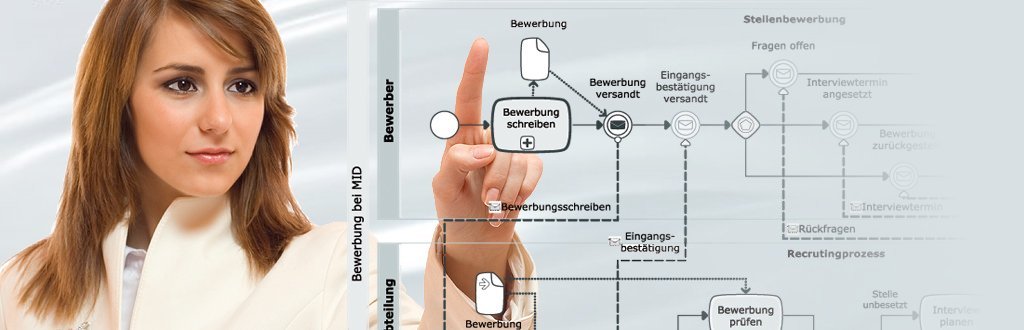
Why Model?
What speaks in favor of modeling? What are the advantages?
Models can be used to realize structures, processes and their relationships which need to be changed or are new. With their detailed analysis and design views, models can be used as a form of documentation which is clearly structured and can easily be read right from the point of creation. Models are such an organic part of the whole model-supported development process.
Models provide operating and IT departments with established standards (Business Process Model and Notation, Unified Modeling Language etc.) to be used for analysis and design. Both departments use formalized system descriptions which can be easily interpreted. Unique model-based specifications enable project goals to be carried out smoothly, easily and in a controlled fashion.
Models are the safe option when applying the "think first, act second" method. You are forced to view processes more abstractly and examine them more closely, which leads you to question relevance, consistency and uniformity; this then leads to a considerably higher quality with regard to analysis and design. Models mean that affected and required system components can be easily identified.
Models can significantly increase the productivity of development processes. Models epitomize formalization for analysis and design and, in doing so, form e.g. the basis of software engineering. Even if a software's entire code cannot be generated, productivity is still increased to such an extent that developments tailored to suit the user's needs can still be conveniently implemented.
If structures and flows have tangible models this means that it is easier to plan, control and implement how they can be further developed and tailored to new situations. The effects of changes can be identified earlier and more easily. This reduces maintenance costs for existing systems. Merging systems also has a reliable basis in models.
How to Successfully Model
The modeler first needs to clear up a few questions before they can successfully model.
- Purpose of model
The purpose of the model and its components needs to be clearly defined to enable the establishment of abstraction rules for the modeling and the checking of the modeling results. - Model language
Before the modeler actually start modeling, they need to establish which language is most suited for the purpose of the model. The language defines the semantic and notation which can be used by the elements.
These prerequisites for successful modeling apply at a base level, e.g. the same applies for technical designs and process models. Modeling standards provide established language elements along with their semantics and notation for specific application fields.
Setting Model Language
The counterpart for abstraction rules can be found in a modeling standard in the metamodel. The metamodel sets which model should be created, which elements are needed for a model, how a model is set out, which dependencies and/or transitions there are between these models etc.
By using a specific notation element, the modeler essentially decides to use a specific armory of modeling options. Even once the metamodel has been configured, it is still only possible to define these options within the framework of the respective metamodel. This is done by specializing elements and limiting their use.
The model types supported by Innovator examine companies as sociotechnical systems which are made up of elements and relationships and which processes run in. Mapping is carried out using modeling elements which represent the relevant properties and relationships of the objects being examined (structures, flows) in an appropriate way. Roles and authorizations support the modeling process which divides labor and offer increased security and clarity.
This chapter contains the topics: