Splitting Flows with Gateways
Insert gateways to split flows and define their type for defining flow behavior.
Inserting a Gateway
Context
Gateways branch the flow or join branches.
The gateway type and flow effect properties set the behavior of the respective gateway.
The flow behavior (exclusive, inclusive, parallel or complex branches or merges) are set by the type of gateway. This type needs to be set by the modeler.
The flow effect (fork, join or merge) are controlled by its own attribute and automatically recognized by Innovator using the in or outflowing sequence flow.
How to proceed
- Insert a gateway into the process.
-
Right mouse click on the gateway.
The context menu and another mini toolbar with the available gateway types are shown.

-
Click on the type you want; clicking on an empty rhombus makes the gateway unspecified.
The desired type is set as the property and the appropriate marker is shown in the gateway icon.
Alternatively, you can also change the gateway type directly in a gateway's Properties.
Defining Standard Flows
Context
You can set which sequence flow should run if no other conditions apply. You can set no more than one default flow within the respective other sequence flows.
How to proceed
- Select the sequence flow which you want to define as the default flow.
-
Activate the is Default check box in the Properties tool window.
The sequence flow is the default flow and will be run through if no other conditions apply. If another flow was the default flow before, then this check box is deactivated.
Defining a Local Condition on a Sequence Flow
Context
Conditions normally need to be defined or a default flow needs to be set on outflowing sequence flows for data-based exclusive or inclusive gateways and/or a complex gateway.
Conditions can be defined as a local condition directly on a sequence flow.
How to proceed
- Select the sequence flow which you want to create a condition for.
-
Enter the condition's text in the Properties tool window as a value of the property condition (local).
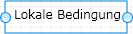
The text is shown in its own field on the sequence flow. The size of the text box can be changed using the frame surrounding the text box.
Using a Global Condition on a Sequence Flow
Context
Conditions normally need to be defined or a default flow needs to be set on outflowing sequence flows for data-based exclusive or inclusive gateways and/or a complex gateway.
You can use a condition already defined as its own model element (expression).
How to proceed
- Select the sequence flow which you want to create a condition for.
-
Activate the Uses Global Condition check box in the Properties tool window.
The Condition (local) Properties box is replaced by Condition (global).
-
Click on the selection button.
The selection dialog appears.
-
Select the condition you want and confirm the selection with [OK].
The condition is inserted and shown in the diagram on the sequence flow. The size or position of the text can be changed using the frame surrounding the text box.