Innovator for Business Analysts provides you with various diagrams, a specification editor and other resources for editing your project.
Diagram Editors
The following diagram types can be displayed and edited:

|
Requirement DiagramRequirement diagrams describe the requirements placed on your system, their properties and the dependencies between the requirements. A requirement contains the description of the desired quality and capability that a system must have in order to fulfill a contract or comply with a standard, specification or other formally prescribed documents. |

|
BPMN Process DiagramsProcess diagrams can be used for displaying and developing processes, as well as modeling the coordinated interaction of two or more processes using the participants of a collaboration. Interactions between participants are also modeled. |

|
Mask Flow DiagramsThe mask flow diagram enables users of an IT application in the operating department to communicate their requirements in the form of masks, dialogs or windows. Mask flows can be tailored to suit almost all processes by extending the BPMN notation accordingly. |
|
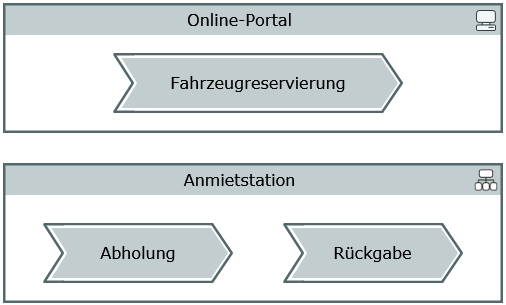
Process MapProcess maps can be used for displaying and developing processes, as well as modeling the coordinated interaction of two or more processes using the participants of a collaboration. Interactions between participants are also modeled. |

|
Business Resource Diagrams and Organizational ChartsBusiness resources diagrams show how business resources are connected, e.g. roles, positions and IT resources. Org charts are a special type of business resources diagram which only describe the organizational structure; organizational structures and people are relevant in an org chart. |

|
Structure Diagram for Business ObjectsStructure diagrams describe the structure of a business object. Nested structure definitions are used for this and displayed in the diagram. |

|
Diagrams for Business Object StatesDiagrams for business object states describe the behavior of a business object. States and transitions between these states are used for this and shown in the diagram. |

|
DMN Decision Requirement DiagramsDecision requirement diagrams denote a domain of decision-making in which you depict the most important decision elements and their dependencies. |

|
Boxed Expression Editors for Decisions and Business LogicsYou can use the boxed expression editors for decisions and business logics to describe their logic graphically using nested table structures. These contain FEEL expressions ("Friendly Enough Expression Language") which are textual notations for formal specification of decision logics. |

|
Table Editor for ContentTables for content enable the clear and convenient editing of requirements. use cases, technical terms or concepts in a selected structure element other selections, e.g. in the result region. |
|
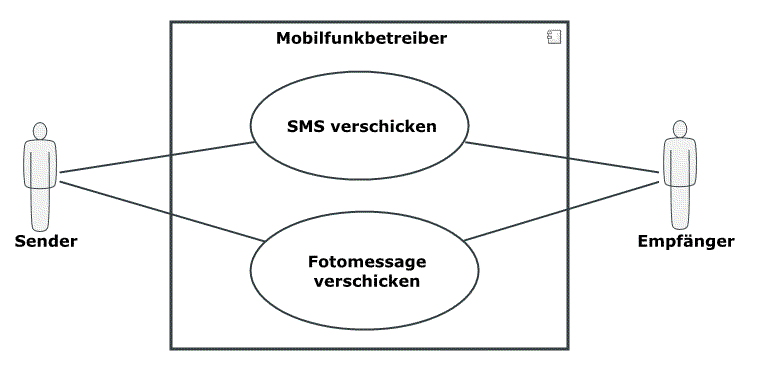
UML Use Case DiagramsUse case diagrams show the relationships between actors and a set of use cases of the system being viewed. |
|
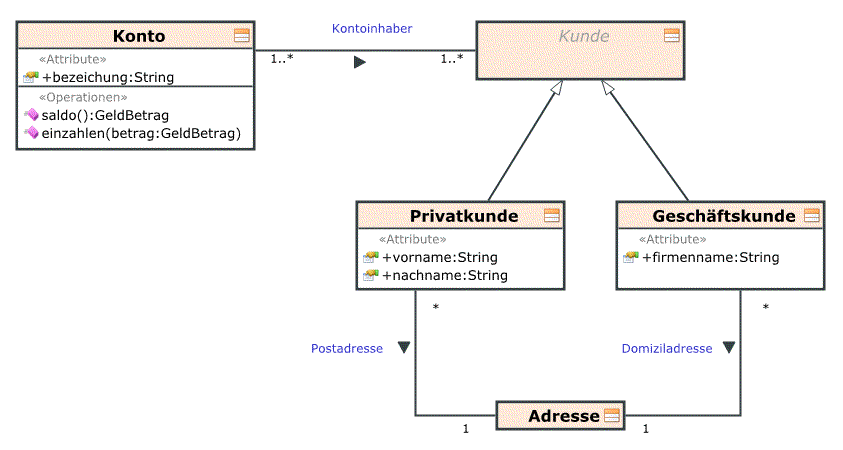
UML Class DiagramsClass diagrams are the central diagram type of UML. They describe a system's classes, its properties, operations and relationships between classes in the context of business process modeling. |
|
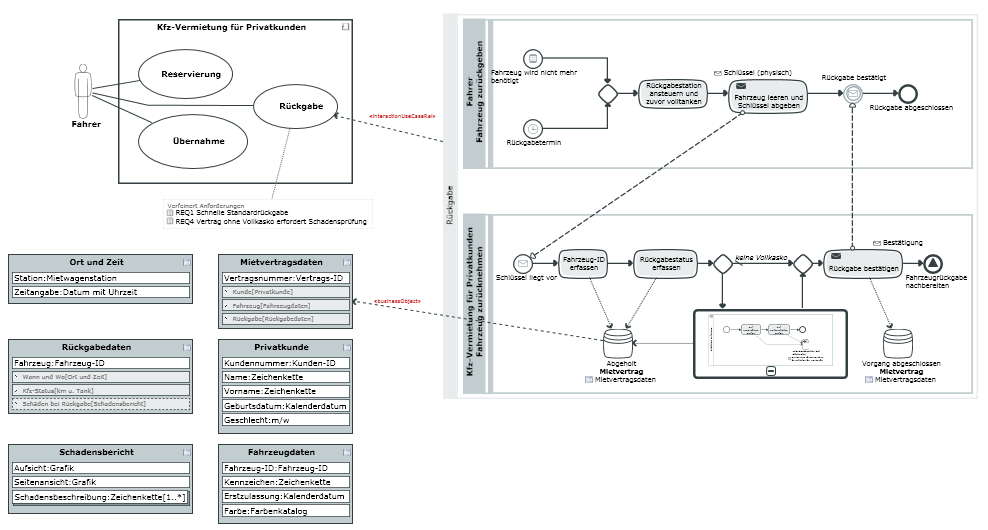
Whiteboard DiagramsWhiteboard diagrams enable visualization of relationships between model elements which would otherwise have to be visualized in different diagram types. |
Other Editors
There are special editors for certain functions; these interfaces can be called many times.

|
Specification Texts for Describing Model Elements and RequirementsYou can store descriptive texts for Innovator elements as specifications; these can then be used e.g. in model documentation. Requirements form the basis of every development project, regardless of whether it is a new development or working on an existing project. |

|
Impact AnalysisImpact analysis uses analysis graphs to depict the interconnection of model elements. The display can be configured. |

|
Dependency EditorThe Dependency Editor is used for easily editing dependencies between various elements independently of a diagram. |

|
BeamerThe Beamer tool window supports the role-based, flexible and transparent mapping of elements and can be configured in many ways. |

|
Align ModelsThe Align Models editor is used for comparing elements from the current model or from the current model and another one. You can use filters to make the evaluation easier to read. |
 Related Topics